

Take Control of Your Sexual Health
/Taking control of your sexual health is one of the most empowering forms of self-care you can practice. It isn’t just about avoiding a diagnosis; it’s about fostering a lifestyle of confidence, transparency, and mutual respect with your partners. While medical advancements have given us more tools than ever before, the key to staying healthy is understanding how to layer these tools effectively.
1. PrEP: Your Shield Against HIV
PrEP (Pre-Exposure Prophylaxis) has fundamentally changed the landscape of HIV prevention. When taken as prescribed, it is highly effective in reducing the risk of getting HIV from sex by about 99%.
Daily PrEP: The most common form, involving one pill taken every day. This creates a consistent level of protection in your system.
PrEP 2-1-1 (On-Demand): For some, taking a pill daily isn't necessary. This method involves taking doses specifically around the time of sexual encounters. Note: Consult with a healthcare provider to see if this regimen is right for your specific needs.
Injectable PrEP: For those who struggle with daily pills, long-acting injections (given every two months) are now an option.
Important Limitation: PrEP is designed specifically to block HIV. It does not protect against syphilis, gonorrhea, chlamydia, or HPV. This is why a "PrEP-only" strategy is often incomplete.
2. Condoms: The All-In-One Barrier
If PrEP is the specialized shield, condoms are the reinforced armor. They remain the only method that provides significant protection against the majority of STIs transmitted through fluid exchange or skin-to-skin contact.
Bacterial Protection: They are the primary defense against gonorrhea and chlamydia.
Viral Mitigation: While not 100% effective against skin-to-skin viruses like HPV or Herpes (HSV), they significantly reduce the viral load and the surface area of exposure.
Lubrication Matters: Always use water-based or silicone-based lube with latex condoms. Oil-based products (like lotion or coconut oil) can degrade the latex, leading to breakage.
3. Doxy-PEP: The "Morning After" for STIs
A newer addition to the sexual health toolkit is Doxy-PEP. This involves taking a specific dose of the antibiotic doxycycline within 72 hours after unprotected sex. Recent studies have shown it can reduce the risk of HIV, syphilis, chlamydia, and gonorrhea by 60-80%.
Think of Doxy-PEP as a safety net—it’s not a replacement for condoms, but it’s an incredible tool for those in high-prevalence communities or for instances where a barrier fails.
4. The Power of Routine Testing
The most dangerous STI is the one you don’t know you have. Many infections are asymptomatic, meaning you can feel completely healthy, have no visible sores or discharge, and still transmit the infection to others.
Why Every 3–6 Months?
Window Periods: Some infections take time to show up on a test. Regular intervals ensure that if you were in a "window period" during your last check-up, the infection is caught in the next one.
Early Intervention: Bacterial STIs like syphilis can have long-term neurological effects if left untreated. Early detection makes treatment as simple as a round of antibiotics.
Normalizing the Conversation: When you make testing a routine part of your calendar (like a dental cleaning), it removes the "scare factor" and reduces the stigma for everyone in your community.
5. Navigating the Conversation
Communication is just as vital as medication. Being able to say, "I was last tested in January and I'm on PrEP—how about you?" isn't just about safety; it's about intimacy. It establishes a baseline of trust.
If you find it difficult to start these conversations, remember that someone who respects your body will also respect your boundaries and your health.
Where to Get Tested/Resources
If you don't have a regular primary care doctor, or don’t want to talk to them about your sexual health, here are some free options available:
Free Condoms: https://www.useacondom.com
If you know that you have HIV: https://hivcare.org
Free testing and PrEP/PEP prescriptions: https://www.freestdcheck.org
Summary Table: Your Prevention Toolkit
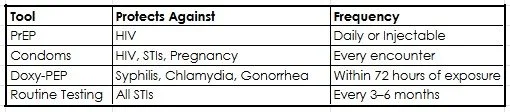
By combining these methods, you aren't just reacting to risks—you are proactively managing your well-being. Knowledge is power. Stay tested, stay protected, and stay confident in your choices.
